
Worried that a nose job in Korea means a tall implant and a nose that stops looking like yours?
It doesn't have to. Asian rhinoplasty usually adds structure where a Western nose job removes it: the bridge is raised with an implant or your own tissue, and the tip is held up with cartilage. Stitches come out 5–7 days after surgery, and fine swelling in the tip settles over months.
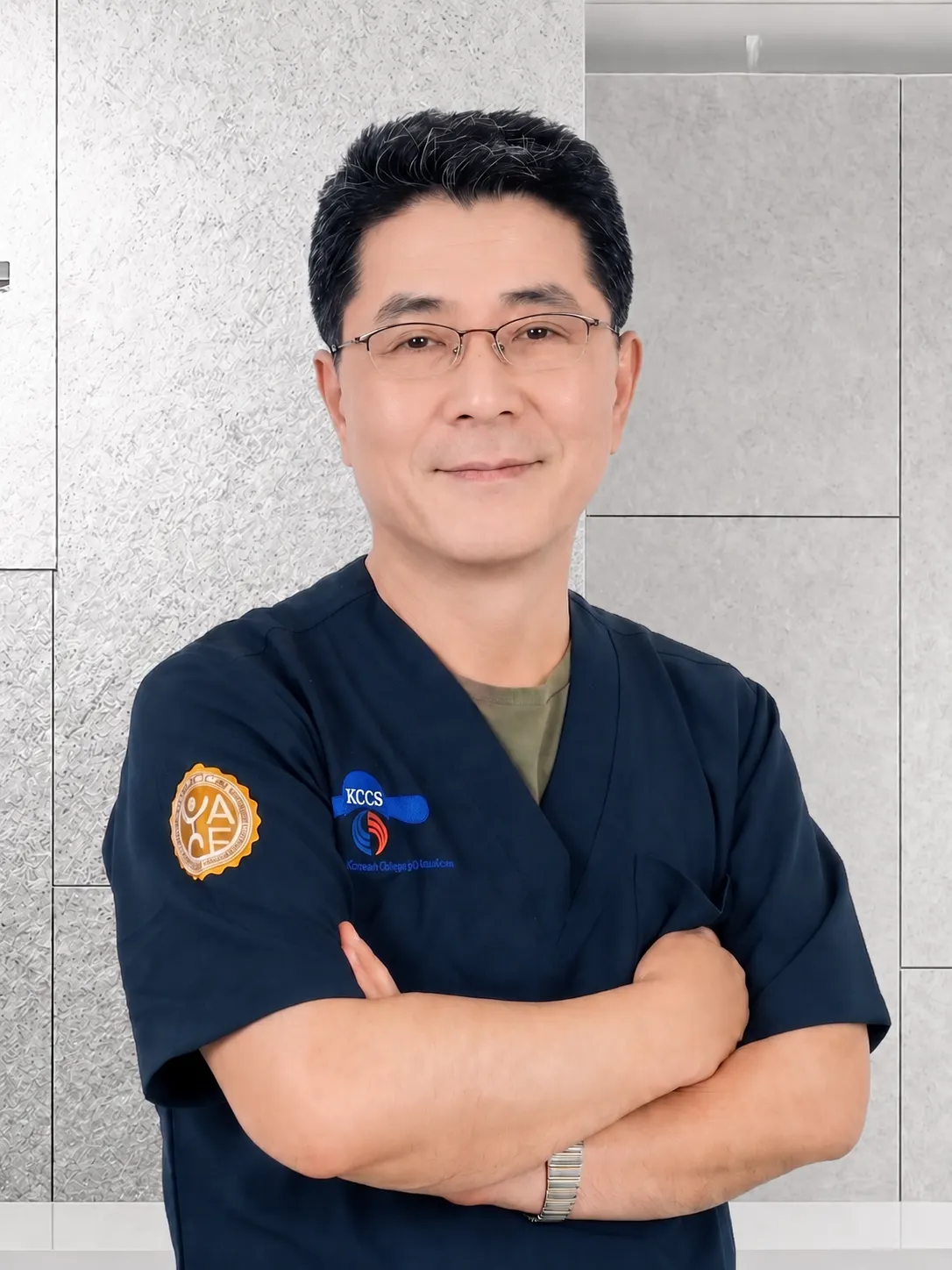
Hello, I'm Dr. Bae Seung-joo, Director at Pascal Clinic in Gangnam, Seoul.
I'm a board-certified plastic surgeon, and I trained in reconstructive plastic surgery at MD Anderson Cancer Center in Houston, Texas. That training bears on this question, because building a nose out of cartilage is reconstructive work. You meet your surgeon at your consultation, and a medical interpreter for your language is provided at no extra charge.
The consultation is free. Send a front photo and a side photo on WhatsApp with the one thing you'd change about your nose. A coordinator passes them to your surgeon and replies with options.
Send front and side photos of your nose on WhatsApp
Get a free consultation in 1 minuteWhat makes Asian rhinoplasty different from a Western nose job?
The direction of the work. A typical Western rhinoplasty takes away: a hump is lowered, a wide tip is narrowed. Asian rhinoplasty more often adds, because the starting point tends to be a lower bridge, a rounder tip and thicker skin. Noses differ inside every group, so treat this as a common pattern and expect your own exam to show its own details.
Think of a tent. The skin is the canvas and the cartilage is the pole. In many East Asian noses the canvas is heavy and the pole is short and soft. Trim a soft pole and the tent sags. So the surgeon lengthens and stiffens the pole with cartilage, and the canvas drapes over it. The thicker the skin, the less fine detail shows through it, which is why definition has to come from the framework underneath.
The Asian rhinoplasty Korea is known for grew out of this build-up approach. At my clinic, rhinoplasty for a low nasal bridge raises the height of the bridge and the tip, using an implant or your own tissue.
A taller bridge is the easy part
A common belief is that the operation is about height: choose an implant, choose how tall, done. I'd correct that. Raising a bridge is the shorter step. The tip decides whether the result looks like your nose or like something placed on your face.
Two limits explain why. First, your skin sets how much height it can carry. An implant that is too tall for the skin stretches it, and over years the outline can show or the skin can thin. Second, a raised bridge next to an untouched round tip looks out of balance from the side. The tip has to come forward with it, and that takes cartilage.
So in an Asian rhinoplasty consultation, the questions that matter are about the tip: how firm your septum is, how thick the skin over the tip is, and how far the tip can move forward without straining that skin. What I aim for is a result that looks like your own face.
Implant or your own cartilage: which suits you?
In Asian rhinoplasty, many plans use both, in different places. The table shows where each material usually goes in general surgical practice.
| Material | Usually used for | Main trade-off |
|---|---|---|
| Silicone implant | Bridge height | Can shift, show through thin skin or get infected |
| Septal cartilage | Supporting the tip | Limited supply in a small septum |
| Ear cartilage | Shaping or padding the tip | A second incision behind the ear |
| Rib cartilage | Larger builds and many revisions | A chest incision, and the graft can warp |
Say you're 29, your glasses slide down a low bridge, and your tip is round with thick skin. I would not start from implant height. I'd start from whether your septum can supply enough cartilage to hold the tip forward. If it can, a modest bridge implant over a supported tip is a common plan. If the septum is small, ear cartilage enters the conversation, along with its extra incision.
If an earlier operation has left asymmetry, inflammation or implant movement, that is revision rhinoplasty, a separate operation planned around the tissue the first surgery left. Which materials fit you is confirmed in person, because the right procedure and extent depend on your anatomy.
Asian male rhinoplasty: what changes?
The proportions change more than the technique. In Asian male rhinoplasty the bridge usually stays straighter and stronger, the tip is rotated upward less, and the nostril base is narrowed with caution, since over-narrowing is what makes a nose look operated on.
Two practical points. And if you wear glasses every day, say so early. Frames usually can't rest on the bridge for several weeks after surgery, so pack contact lenses or another workaround before you fly.
How long does Asian rhinoplasty in Korea take, start to finish?
Plan your Seoul stay around one visit: stitch removal, 5–7 days after a first rhinoplasty. Daily life resumes within those same 5–7 days, and after a revision you should plan on 7 days. The tip keeps refining long after you're home. The American Society of Plastic Surgeons notes that the new nasal contour can take up to a year to fully refine.
Time in the operating room follows the plan. Raising a bridge alone is shorter than a tip build that needs cartilage taken from the septum or ear, so ask for the estimate once your own plan is set.
One scheduling detail catches travelers out. My clinic is open Monday to Friday 10:00–19:00 and Saturday 10:00–17:00, and closed on Sundays and public holidays. Count forward from your surgery date and check that your stitch-removal day isn't a Sunday or a Korean public holiday before you book the flight home.
Bleeding, infection and implant shift: the risks, and who should wait
Swelling, bruising under the eyes, a blocked nose and a numb tip are common in the first weeks and usually ease on their own.
Surgery carries risks such as bleeding, infection and inflammation, and your surgeon explains them before you decide. Specific to Asian rhinoplasty with an implant: the implant can move or show, the nose can heal unevenly, breathing can feel tighter, and some people need a second operation. Individual results vary. An open approach also leaves a small incision on the skin between the nostrils. It usually fades to a fine line, and if any scar heals wide or raised, scar revision surgery in Seoul is a separate treatment I also perform.
As general guidance, wait or skip surgery if:
- you're under 18 or your face is still growing
- you smoke and can't stop around the surgery
- you take blood thinners or have a bleeding disorder your doctor hasn't cleared
- you have an active infection in the nose or sinuses
- an earlier nose operation is still settling, which often takes about a year
Once you're home, a fever, spreading redness, bleeding that won't stop or a bridge that suddenly looks crooked means seeing a local doctor that day, and sending a photo on WhatsApp as well. Before you leave Seoul, ask for a written note of what was placed: the implant type and where any cartilage came from. A doctor at home can act faster with it.
If the calendar is your sticking point, message your travel dates on WhatsApp and mention two things: whether you wear glasses, and whether you've had filler or surgery in your nose before. Those details shape the options that come back.
Send front and side photos of your nose on WhatsApp
Get a free consultation in 1 minuteWhat to ask any clinic about Asian rhinoplasty before you book
- Who operates, and do I meet that surgeon at the consultation?
- Which material goes on the bridge and which in the tip, and why for my skin?
- Where would cartilage come from if my septum is too small?
- On which day do stitches come out, and is the clinic open that day?
- Is the quote written after an exam, and what would change it?
- If something looks wrong after I fly home, who do I contact and how?
These work at any clinic, mine included. Take them wherever you go.
Doctor's note
Height is what people usually ask for, and support is what decides the result. A nose has to hold its shape through years of smiling, sleeping on it and wearing glasses, so I would sooner build a slightly lower bridge on a firm tip than a tall one on a soft tip. If your skin is thick, I'll tell you that fine definition has a ceiling. I'd rather you hear that before you fly than after.
Asian rhinoplasty in Korea doesn't have to be decided this month. What settles the plan for you is how firm your septum is and how thick the skin over your tip is, and I check both in person at 157 Dosan-daero, a short walk from Sinsa Station Exit 8. The consultation is free, and the first message is small: a front photo, a side photo and your nose history on WhatsApp, with one question, whether your own septum is likely to be enough for the tip you want.
— Dr. Bae Seung-joo, Director
Frequently asked questions
Is an Asian nose rhinoplasty always done with an implant?
No. A small rise in the bridge can sometimes be built with your own tissue, and the tip is usually supported with cartilage whichever way the bridge is raised. At Pascal, rhinoplasty for a low nasal bridge uses an implant or your own tissue, and which one fits is confirmed at the exam.
Can a bridge implant be taken out later?
A silicone implant can generally be removed, but removal is a revision operation. The skin and the tissue around the implant have changed by then, so the nose rarely returns to exactly how it started. Pascal treats revision cases for noses; send photos and the details of your earlier surgery when you ask.
What moves the quote for a nose?
Rhinoplasty at Pascal is quoted after an exam, because the extent of surgery differs from nose to nose. Ask on WhatsApp what applies to your case, with front and side photos.
Will my nose feel stiff when I smile?
For the first months, often yes. A tip supported with cartilage is firmer than before, and the upper lip can feel tight when you smile or laugh. This usually eases as swelling goes down and the tissue softens, though a supported tip stays firmer than an unoperated one.
This article is general information, not medical advice. Individual results vary, and surgery carries risks such as bleeding, infection and inflammation. Your surgeon confirms suitability at an in-person exam. Read the medical disclaimer.
Scar reconstruction · Facelift · Rhinoplasty · Eyelid surgery · Skin