
Thinking about a Korea forehead implant but worried the edge will show under your skin, or that it's more surgery than your flat forehead really needs?
Read this before you book a flight for it.
By the end you'll know what decides the cost, what reviews get right and wrong, and how the three methods for a flatter forehead differ. That's enough to tell which approach fits your forehead and your budget.
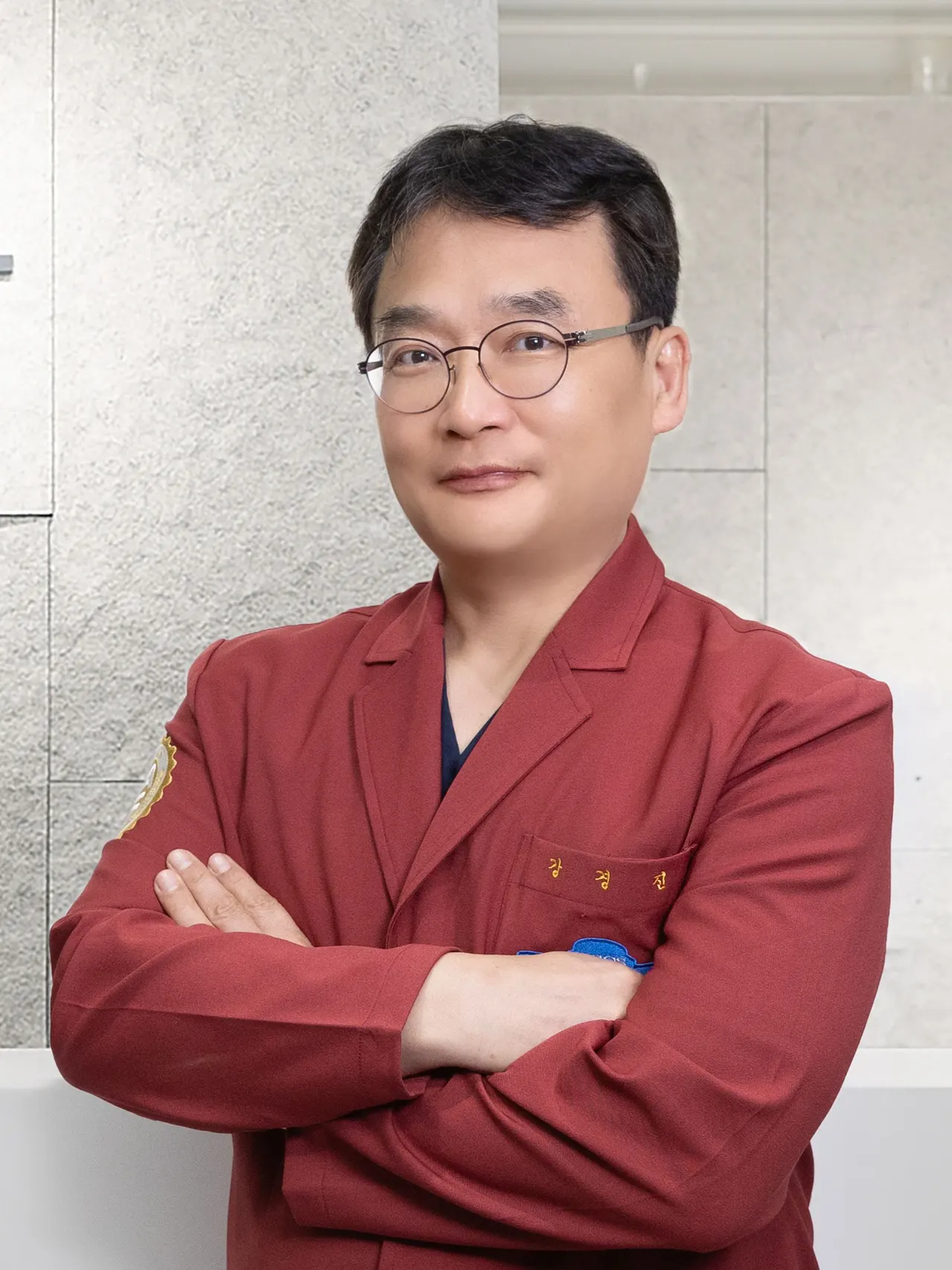
Hello, I'm Dr. Kang Kyoungjin, Representative Director of Pascal Clinic in Seoul.
I hold a PhD in anatomy and was a professor of anatomy at Daegu Catholic University School of Medicine before I moved into plastic surgery. I developed SAFI, a lifting fat-grafting method. At Pascal, plastic surgery, dermatology and oral & maxillofacial surgery work in one building in Sinsa, and our price list is published on the site.
I wrote this because many people who search for a Korea forehead implant are looking at a dip in the soft tissue, and the method should follow what sits under the skin.
A forehead implant is a preformed silicone piece placed on the bone through an incision in the scalp, to build a flat or sloping forehead forward. Silicone forehead implants aren't on Pascal's treatment list. For forehead volume I use your own fat or dermal filler, and which one fits depends on your anatomy.
If you can't tell whether your forehead is flat at the bone or just thin over it, send one side-profile photo in daylight with your hair pulled back on WhatsApp, and ask one question: fat or filler for this forehead?
Send a side-profile photo of your forehead on WhatsApp and ask: fat or filler?
Get a free consultation in 1 minuteWhat is a forehead implant, and how does it work?
Most forehead implants are solid silicone, shaped to curve from the brow ridge up toward the hairline. The surgeon makes an incision in the scalp or at the hairline, lifts a pocket under the tissue and slides the implant in so it rests on the bone. Some implants are carved during surgery; others are made to measure from a CT scan.
Because it sits on bone, an implant changes the forehead's shape at the skeletal level, all in one operation. Its weak points are the edges, which can show or be felt under thin skin, and the fact that any foreign body can shift or become infected, sometimes years later.
You may also see bone cement or similar materials mentioned in a Korea forehead implant thread. They build up the bone too, and their trade-offs are close to those of a silicone implant.
Three methods for a flat forehead
Searches for a Korea forehead implant tend to mix three different procedures under one name. They change different layers of the forehead.
| Method | What it changes | Main trade-off |
|---|---|---|
| Silicone implant | Shape at the bone, in one operation | Scalp incision; edges can show under thin skin; can shift or get infected |
| Fat grafting | Soft-tissue volume, with your own fat | Liposuction at a donor site; part of the fat is reabsorbed, so a second session may be needed |
| Dermal filler | Soft-tissue volume, by injection | No incision; broken down over time; forehead vessels make placement critical |
With facial fat grafting, fat is taken by liposuction from an area where you have some to spare, prepared, and injected in small amounts across the forehead. The American Society of Plastic Surgeons lists fat injection as one type of filler, alongside hyaluronic acid products. The fat that survives generally behaves like the tissue around it.
Hyaluronic acid filler goes in by needle or cannula. The body breaks it down gradually, which some people prefer for a first, smaller change they can live with before committing to more.
Is a Korea forehead implant the right fit for your forehead?
Three things decide the method. First, where the flatness is: a forehead that slopes back at the bone is a different problem from a hollow just above the brows. Second, skin thickness, because thin skin shows whatever lies beneath it. Third, how much change you want and whether you'd accept a second session.
Some foreheads aren't flat at all. If the brow has dropped and the skin above it feels heavy, adding volume won't lift it. That's a forehead lift, an incisional procedure that repositions skin and muscle, or for milder laxity a non-surgical option like Ultherapy and Ultherapy Prime. And sometimes the forehead only looks flat because the mid-face is wide; in that case, read about reshaping wide cheekbones before you decide on the forehead.
Say you're 34, your forehead looks flat in profile, there's a shallow dip just above your eyebrows, and your skin is thin enough that a vein shows at the temple. You came looking for a Korea forehead implant and want one trip to Seoul. With thin skin and a soft-tissue dip, I'd lean away from a solid implant, because its edge is the first thing that would show. Fat grafting fits that picture if you have fat to spare and can accept a possible second session. Filler fits if you'd rather try a smaller change first.
Doctor's note
The forehead is a moving part. Each time you raise your eyebrows, the frontalis muscle lifts and folds the skin over it, so whatever I add has to sit at a depth that moves with you and doesn't ripple. The vessels that supply the forehead also rise from the brow area. That's why the depth and route of any injection there come from anatomy before appearance: it has to work well before it can look good.
For this step a second photo helps: one from the front with your eyebrows raised, so the movement shows. Send it with your side profile on WhatsApp and ask whether fat or filler suits your forehead. A coordinator passes your photos to the surgeon and replies with options.
Send a side-profile photo of your forehead on WhatsApp and ask: fat or filler?
Get a free consultation in 1 minuteWhat reviews of forehead augmentation get right and wrong
Threads about a Korea forehead implant trip tend to repeat three claims.
"The fat all melts away." Partly true. Some grafted fat is reabsorbed in the first months, which is why a second session may come up. The fat that remains after that generally stays as living tissue.
"Filler in the forehead is quick and harmless." The quick part is true. The FDA warns that filler can be injected into a blood vessel by accident, which can block blood flow and, rarely, cause skin damage or vision problems. In the forehead, depth and technique matter.
"An implant is done once and forgotten." An implant doesn't wear off like filler, but it can shift, show at the edges, or need removal if it becomes infected, sometimes years later.
What decides the cost of forehead augmentation
A Korea forehead implant quote and a fat or filler quote are built from different parts. For your forehead, these move the cost:
- Method: fat grafting involves liposuction and an operating room; filler is an injection visit.
- Amount and area: the forehead alone, or the forehead with the temples or the brow line.
- Anesthesia: what level is used for liposuction and grafting.
- Sessions: whether a second fat session or a filler top-up is likely.
- Days in Seoul: the exam, the procedure and the days you stay before flying.
Our published price list excludes VAT. Final quotes follow your exam, because the right procedure and extent depend on your anatomy. Ask on WhatsApp what it would cost for your forehead, with your front and side photos.
Risks and side effects to know
Swelling, bruising and a tight feeling are common after fat grafting or filler and usually settle over days to weeks. With fat grafting, the donor site bruises too, and patches of numbness can last longer.
As general medicine, wait or skip treatment if you have an infection, a rash or inflammation on the forehead, a recent laser or peel there, are pregnant or breastfeeding, or have a known allergy to a filler ingredient. Tell your surgeon about blood thinners and bleeding problems.
After you fly home, sudden pain, pale or dusky skin, or any change in vision after filler needs emergency care right away. Redness, heat or fever suggests infection; see a local doctor promptly and message the clinic with photos. Surgery carries risks such as bleeding, infection and inflammation, and your surgeon explains them before you decide.
Planning your days in Sinsa
Pascal is at 157 Dosan-daero in Sinsa-dong, a short walk from Sinsa Station Exit 8 (Line 3 and the Shinbundang Line). We're open Mon–Fri 10:00–19:00 and Sat 10:00–17:00, closed Sundays and public holidays. If you land on a Saturday evening, Monday is your first clinic day, so count from there.
Your surgeon confirms suitability at an in-person exam. Leave spare days before your flight for swelling to settle, and ask how many when you book. If you're also weighing other contouring, our piece on softening the cheekbone line explains how the mid-face changes forehead proportions.
Your next step is small. Send one daylight side profile with your hair pulled back on WhatsApp, and ask the question you care about most, whether that's fat versus filler or what it would cost for you. When you come in, your surgeon examines your forehead and recommends the method that fits its structure.
Frequently asked questions
Does Pascal place silicone forehead implants?
Silicone forehead implants aren't on Pascal's treatment list. For forehead volume, the options are fat grafting with your own fat or dermal filler, chosen after an in-person exam of your forehead.
Can a forehead lift make a flat forehead rounder?
No. An incisional forehead lift repositions drooping skin and muscle along the brow. It doesn't add volume, so it treats a heavy, low brow rather than a flat or sloping forehead.
How long does forehead filler last?
Hyaluronic acid filler is broken down by the body gradually, over months.
Will forehead fat grafting leave a visible scar?
Fat grafting uses small entry points for liposuction and injection rather than a long incision. They usually fade to small marks. A silicone implant, by contrast, needs an incision in the scalp or at the hairline.
Can I fly home soon after forehead fat grafting?
Ask how many days to leave before your flight when you book.
This article is general information, not medical advice. Individual results vary, and surgery carries risks such as bleeding, infection and inflammation. Your surgeon confirms suitability at an in-person exam. Read the medical disclaimer.
Eyelid surgery · Fat grafting · Lifting · Fillers · Skin