A face thread lift is not a smaller facelift. It is a temporary scaffold: absorbable medical threads placed in the dermis or the SMAS layer that lift sagging skin while they hold. If you're in midlife and weighing a face thread lift in Seoul, that difference decides almost everything. Threads suit early, mild sagging with enough volume left underneath. When jowls, a loose neck and deep folds have arrived together, a surgical lift usually does more, and the exam is where that line gets drawn.
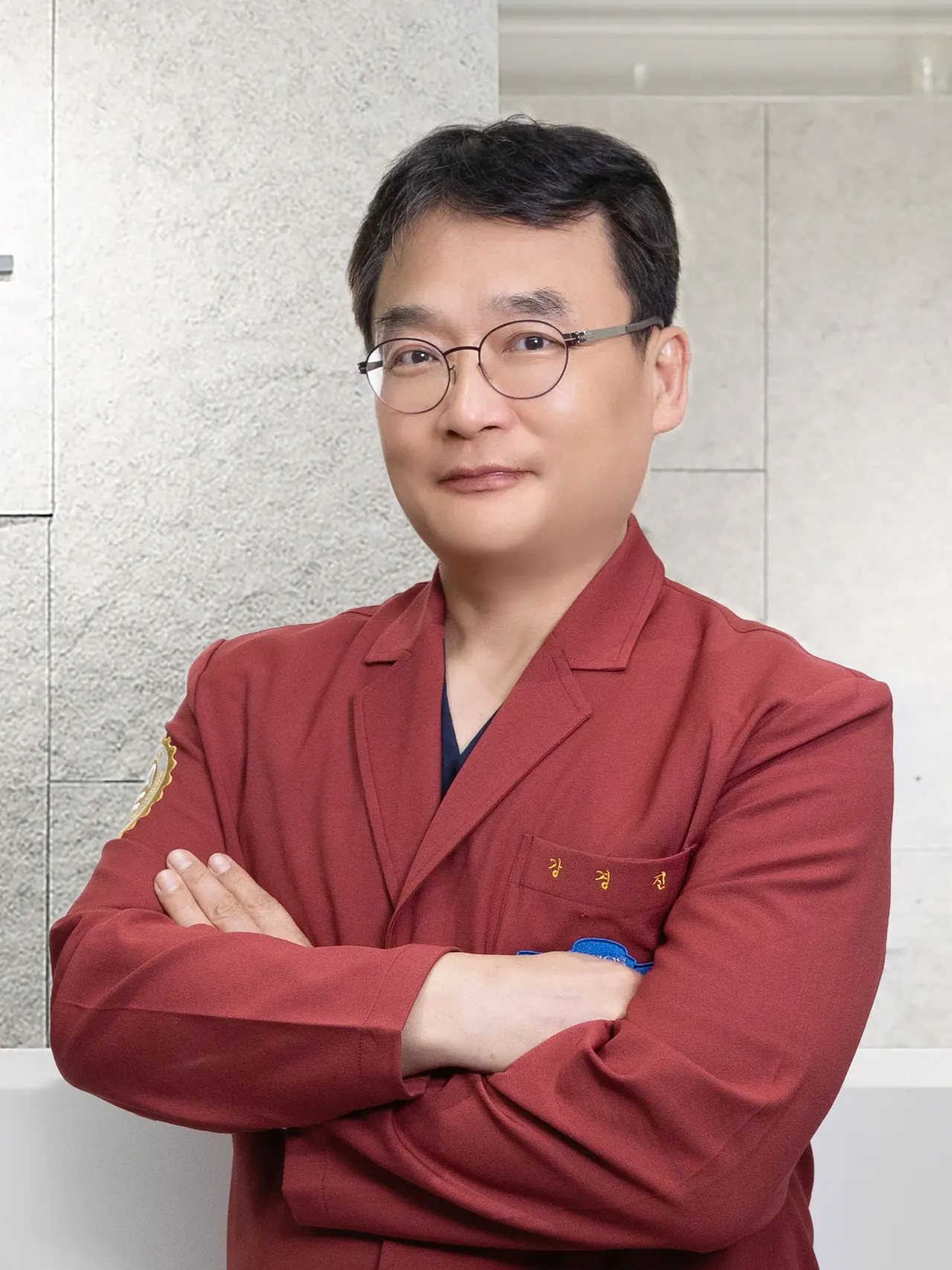
I'm Dr. Kang Kyoungjin. I taught anatomy at a medical school before moving into plastic surgery, so this article reads the face in layers: skin, fat, the SMAS and the bone underneath. Each layer ages differently, and each treatment reaches only some of them.
What a thread face lift changes in a midlife face
A thread face lift repositions soft tissue. It does not remove skin, and it does not add volume. Pascal uses COG and Mint threads, and the type and placement are chosen after the exam.
In your forties, fifties and beyond, three things tend to happen at once. Skin loses elasticity. The fat pads of the cheek slide down and thin out. Bone support behind the cheek and jaw recedes a little. Threads work on the second problem, and only while the skin above them is still light enough to follow.
The American Society of Plastic Surgeons describes thread lifts as a less invasive option whose results are more modest and shorter-lived than a surgical facelift. Because the threads are absorbable, the lift isn't designed to last the way surgery does.
Threads also leave skin texture alone. Fine lines, pores and uneven tone sit in the surface layer, and that is what most searches for a korean face laser are really about. At Pascal, the UltraClear fiber laser belongs to that conversation, not the thread one.
When does sagging outgrow threads?
Usually when the skin itself has become loose and heavy, when the neck has started to hang, or when the folds beside the nose and mouth stay deep at rest. At that point a thread is pulling on stretched skin, and the pull shows.
A simple mirror check gives you a rough idea before any appointment. Sit upright, relax your face, and press your cheek gently up and back toward your ear with two fingertips. If a small push gives a natural-looking jawline, the tissue may still respond to threads. If you need a large push, or the neck stays loose while the cheek moves, a deeper lift is more likely to match the problem. This is only a home impression; it does not replace an exam.
Two other patterns often get mixed into searches for a face thread lift in Seoul:
- Heavy brows. When the brow sinks, the upper eyelids can look heavier. An incisional forehead lift lifts the skin and muscle layer of the forehead and brow; cheek threads don't reach it.
- A face that thinned fast. After rapid weight loss, the face often looks hollow rather than saggy. That calls for volume, and fat grafting addresses that layer. Lifting a deflated cheek with threads can look tight instead of rested.
Threads, facelift or forehead lift, side by side
When people search "korean face lift", they often mean any of these three. The facts below come from Pascal's treatment pages. Where a cell says "set at your exam", the clinic has not published a fixed figure, because it depends on what is done.
| Thread lifting | Facelift & neck lift (SMAS) | Forehead lift | |
|---|---|---|---|
| What it moves | Soft tissue, held by absorbable threads in the dermis or SMAS | Skin and the deeper SMAS layer | Skin and muscle layer of the forehead and brow |
| Type | Non-surgical | Surgical, incision in front of or inside the ear | Surgical, incision along the hairline or inside the scalp |
| Anesthesia | Set at your exam | Sleep or general | Sleep or general |
| Operating time | Set at your exam | About 2–3 hours | About 90–120 minutes |
| Back to routine | Set at your exam | Most people in 10–14 days | Most people in 7–10 days |
| Follow-up in Seoul | Set at your exam | Stitch removal plus 2–3 check-ups | Stitch removal plus 1–2 check-ups |
Read the table by your own row of worries. If your main limit is time away from home, the surgical columns tell you which days in Seoul you need to plan around. If your main limit is surgery itself, the thread column is the one to discuss, with realistic expectations about what it can move. Non-surgical ultrasound lifting is a third route; the Ultherapy and Ultherapy Prime comparison covers it. The SMAS facelift and neck lift page has the surgical details.
What decides the choice at the exam?
Four things: how thick and loose the skin is, where the volume sits, whether bone support has receded, and what you actually want changed. The procedure follows from those, not from age alone.
In general, a surgeon assessing a midlife face for threads looks at the face at rest and while talking, because movement shows where tissue has slid. Skin thickness at the cheek matters, since thin skin can show thread edges or dimpling more easily. The profile view shows whether the jawline has softened from the cheek above it or from loose neck skin below it. And the neck is checked with the chin slightly lowered, where laxity is hard to hide.
The goal matters as much as the measurements. Someone who wants a slightly fresher look for a family event is asking a different question from someone who wants the jowls gone. A thread face lift can answer the first. It rarely answers the second.
Doctor's note
Anatomy taught me that the face ages layer by layer, and each layer keeps its own clock. A thread can hold soft tissue that has slid down. It can't replace fat that has gone, and it can't tighten skin that has stretched. So the first question I'd want answered isn't "threads or surgery" but "which layer is the problem". Once that is clear, the choice usually becomes obvious to the patient too.
Send front and side photos on WhatsApp
Get a free consultation in 1 minuteRisks of a face thread lift in Seoul, and who should wait
Bruising, swelling and soreness in the first days are common after threads. Less common are dimpling or puckering, a thread you can feel or see, asymmetry and a thread working its way out. Infection is uncommon but possible.
These are not hypothetical. Complication rates after facial thread lifting were pooled in a meta-analysis that Aesthetic Plastic Surgery discussed in 2021. For you, the practical point is that minor problems like dimpling and visible threads belong in the consent conversation, not in the fine print.
Surgery carries its own list. Pascal's FAQ names bleeding, infection and inflammation, and your surgeon explains them before you decide. The American Society of Plastic Surgeons lists facelift risks including hematoma, nerve injury, scarring and anesthesia risks.
People who should generally wait or discuss timing first:
- anyone with an active skin infection or inflammation in the treatment area
- people who are pregnant
- people taking blood thinners, until their own doctor and the surgeon have agreed a plan
- people whose weight is still changing quickly, because the face will keep changing too
- anyone hoping threads will deliver a facelift-level change
Individual results vary. Your surgeon confirms suitability at an in-person exam.
How does a Seoul trip fit around it?
For a face thread lift in Seoul or a facelift, the procedure sets the length of the trip. A facelift means staying until stitch removal at 7–10 days, with check-ups after that. A thread lift's follow-up is set at the exam, so ask about it before you book flights.
Pascal is at 157 Dosan-daero, Sinung Tower Two (6F–8F), Sinsa-dong, Gangnam-gu, a short walk from Sinsa Station (Line 3 · Shinbundang Line), Exit 8. The clinic is open Monday to Friday 10:00–19:00 and Saturday 10:00–17:00, and closed on Sundays and public holidays. If you land on a Saturday evening, your first realistic consultation day is Monday.
The CDC's medical tourism guidance advises carrying copies of your medical records and arranging follow-up care at home before you travel. It also notes that flying soon after surgery raises the risk of blood clots, which is one more reason to plan the return flight around the surgical schedule rather than the other way round.
If you are arranging this for a parent
Let your parent describe, in their own words, what bothers them in the mirror. The plan starts from their goal, not yours, and that sentence is worth more than any photo you add.
A few practical things help. Write down every medication and supplement they take, including blood thinners. Note any heart, blood pressure or diabetes history. If a surgical lift is on the table, plan for someone to stay with them through the swelling days and the stitch-removal visit. And ask before booking which language the consultation will run in, so nobody is surprised on the day.
If your parent has had eyelid surgery or another procedure elsewhere, bring what records you can. Revision questions are a separate topic, and the scar revision guide shows how earlier surgery changes the planning.
Torn between a face thread lift in Seoul and surgery? Start with photos. Take a front view and both side views in daylight, face relaxed, hair pulled back from the ears and jaw. Send them on WhatsApp with one line about what bothers you most. Your surgeon's team looks at them and replies with options, and the plan is still confirmed at an in-person exam in Sinsa.
Send front and side photos on WhatsApp
Get a free consultation in 1 minuteFrequently asked questions
Is a thread lift considered surgery at Pascal?
No. Pascal lists thread lifting with its non-surgical lifting treatments. Absorbable medical threads are placed in the dermis or SMAS layer to lift sagging skin, and the type and placement are decided after an exam.
Will threads fix a face that looks hollow after weight loss?
Usually not. Threads reposition tissue but don't add volume. A face that has thinned quickly often needs volume restored, for example with fat grafting, and the exam shows which layer is the main issue.
Where is the scar after a facelift and neck lift?
The incision sits in front of or inside the ear, where it blends with natural creases. Stitches come out 7–10 days after surgery, and most people return to routines in 10–14 days.
Which doctor handles lifting treatments at Pascal?
Dr. Kang focuses on eyelid surgery, fat grafting and lifting. Dr. Bae focuses on scar reconstruction, facelift, nose and eyelid surgery, and Dr. Han focuses on facelift. You meet your surgeon at your consultation.
Can I combine a thread lift with skin laser treatment?
They treat different layers: threads reposition soft tissue, while a laser such as the UltraClear fiber laser works on the skin surface. Whether and when to combine them is decided by your doctor at the in-person exam.
This article is general information, not medical advice. Individual results vary, and surgery carries risks such as bleeding, infection and inflammation. Your surgeon confirms suitability at an in-person exam. Read the medical disclaimer.
Eyelid surgery · Fat grafting · Lifting · Fillers · Skin